Jean
The light house: A love storyJean is Connie Dixon’s nineteen-years-older sister, an accountant whose life has narrowed around work, money, and the full-time nursing care required by their mother. Although she remains largely outside the central art-world drama, Jean supplies its most immediate ethical and financial stakes: her exhaustion and fear make visible what Connie’s decisions could cost, while the eventual payment for the paintings releases both sisters from an obligation that had governed their lives.
Identity and Family Position
Jean is presented as the steady daughter in contrast to Connie Dixon, who had been indulged as the child born when their parents were already of grandparental age. Jean studied diligently, worked hard, and built what the narrative calls an obscure life of moderate happiness; Connie pursued artistic recognition and became entangled with Duncan Cartwright. Their difference is not merely temperamental. After their mother required full-time nursing care, Jean and Connie contributed money every week, with Connie’s employer making additional deposits when necessary. The sisters’ relationship consequently became less like an equal adult partnership and more like that of a parent and child, with Jean carrying the practical authority and fatigue of responsibility.
That responsibility is concrete and precarious. The bank maintains a monthly instruction to transfer money from the sisters’ joint account to a nursing-home facility outside Exeter, and the account has no other withdrawals. Jean’s household finances are similarly strained. She works as an accountant for a local firm, but tells Connie that the working days are growing longer, the nights of rest shorter, and the money is stretching less than ever. The nursing-home payment is not an abstract family duty; it is the pressure that leaves Jean with little margin and makes every unexpected withdrawal dangerous.
The Maine Crisis and the Paintings
When Connie calls from Maine, she does not explain everything by telephone. She tells Jean that she is returning early, intends to visit their mother, and hopes to spend the following night at Jean’s house because important matters need to be discussed face-to-face. Jean’s concern is immediate: she asks whether Connie is all right and whether she is in trouble. Connie answers that she is no longer in trouble but postpones the full story, knowing that Jean will need to see the paintings before she can be persuaded.
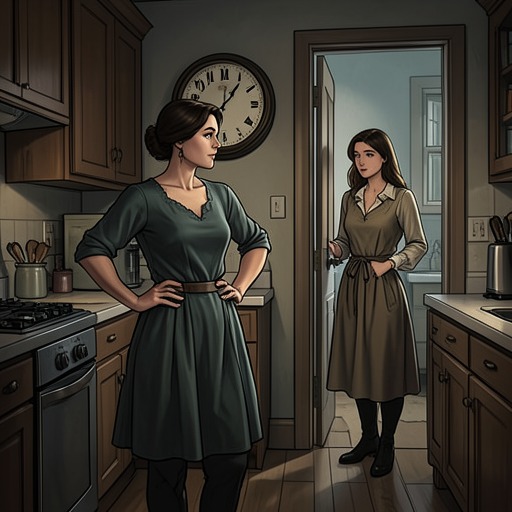
Jean receives her at the old family house after Connie’s forty-minute drive through heavy traffic. Connie arrives carrying a suitcase and a battered briefcase bought at a thrift shop, while the kitchen reflects Jean’s limited means: a new stove and replaced cupboards coexist with faded curtains, a chipped wooden counter, old pipes, enamel mugs, and instant coffee. The domestic setting gives their confrontation an everyday scale. The decision Connie has made in Maine enters not a glamorous gallery but a tired kitchen where the sounds of spoons, boiling water, and a clock intensify the silence between them.
Connie then admits that she withdrew two thousand dollars from the joint nursing-home account to buy something. Jean’s horror is immediate because the money is already assigned to their mother’s care. Connie clarifies that she paid three thousand dollars for two paintings, using the account money together with her last thousand dollars, and identifies them as Blake McGrath originals. She insists that they are worth close to half a million dollars together. Jean cannot accept the valuation; tears of despair run down her face, and she asks whether the seller will return the money. Her reaction establishes the divide between speculative artistic knowledge and the immediate economics of care: to Connie the paintings represent a decisive opportunity, while to Jean they initially look like an irreversible theft from their mother’s security.
Trust, Risk, and Material Consequences
The next morning Jean moves listlessly as Connie loads the suitcase and briefcase into the car. Connie acknowledges that Jean considers her foolish and disapproves of the way she has lived, but asks her to trust the judgment behind the purchase. She promises that, if the plan succeeds, Jean will never again need to worry about the cost of their mother’s care. Jean says nothing, and that silence preserves the seriousness of the request: Connie is asking not only for financial patience but for a temporary suspension of Jean’s established belief that prudence is the only protection available to the family.
Jean’s practical role becomes decisive when Connie takes one of the paintings to Duncan Cartwright and negotiates from a position of newly recognized value. Connie demands that two hundred and ninety thousand dollars be transferred into the account for her mother’s ongoing care, along with five thousand five hundred dollars in cash. She refuses to complete the transaction until she can confirm that the money has reached the account, then calls Jean and orders her, insistently, to check the balance. Jean’s response, heard only through Connie’s reaction, is joyful disbelief: the transfer has arrived, and the risk taken in the kitchen has become financial security.
The final redistribution of the money also shows that Connie does not treat Jean’s relief as a temporary payment. Connie asks Jean to transfer forty thousand dollars into Connie’s own account, leaving a quarter of a million dollars to cover the continuing nursing-home costs. The narration explicitly links this sum to Jean’s liberation from the burden that had buried her life in work and worry. Jean’s labor is therefore not erased by the artistic windfall; it is recognized through the removal of the financial pressure that had consumed it.
Relationship with Connie and Narrative Function
Jean and Connie remain emotionally strained even when they are bound by affection and shared duty. Connie knows Jean means well, yet sees that they inherited different personalities and values. Jean’s steadiness can appear judgmental to Connie, while Connie’s impulsiveness appears to Jean as a threat to the fragile arrangements keeping their family afloat. Their conflict is sharpened by the fact that Jean has effectively had to act as the responsible adult, whereas Connie has long occupied the position of the indulged younger child.
Jean nevertheless functions as a witness whose judgment matters. Connie delays the explanation until she can face her, hides her uncertainty behind a carefree voice during the telephone call, and later tries to reach her through earnestness rather than argument. Jean’s tears, silence, and eventual joyful response mark the changing value of the paintings more powerfully than a market declaration could. The canvases first appear as a reckless misuse of shared care funds; through the payment, they become the means by which that care is secured.
Jean’s importance therefore lies in the moral economy surrounding art. Duncan Cartwright’s money is extracted through Connie’s negotiation, but its first destination is not luxury or artistic prestige: it is the nursing home outside Exeter. The paintings’ value is measured simultaneously in market terms and in the hours of labor, anxiety, and responsibility they remove from Jean’s life. Jean stands at the point where family obligation, economic vulnerability, and artistic speculation meet, making her a quiet but essential counterweight to Connie’s pursuit of freedom.
Later Place in the New Beginning
After the payment succeeds, Jean becomes part of the future Connie is trying to construct rather than merely the person endangered by her past. Connie leaves New York, arranges her belongings for storage, and begins separating herself from Duncan Cartwright; the money transferred through Jean ensures that this departure does not abandon their mother. Jean’s practical stability makes Connie’s artistic and personal restart possible.
The evidence does not give Jean a separate artistic career or a fully described later transformation. It does show that her position changes from exhausted financial guardian to someone whose central worry has been lifted. In that limited but consequential sense, Jean shares in Connie’s redemption: not through painting, romance, or public recognition, but through the conversion of a dangerous act into sustained care and the recovery of a future no longer dictated by unpaid costs.